CRA vulnerability reporting and incident response automation
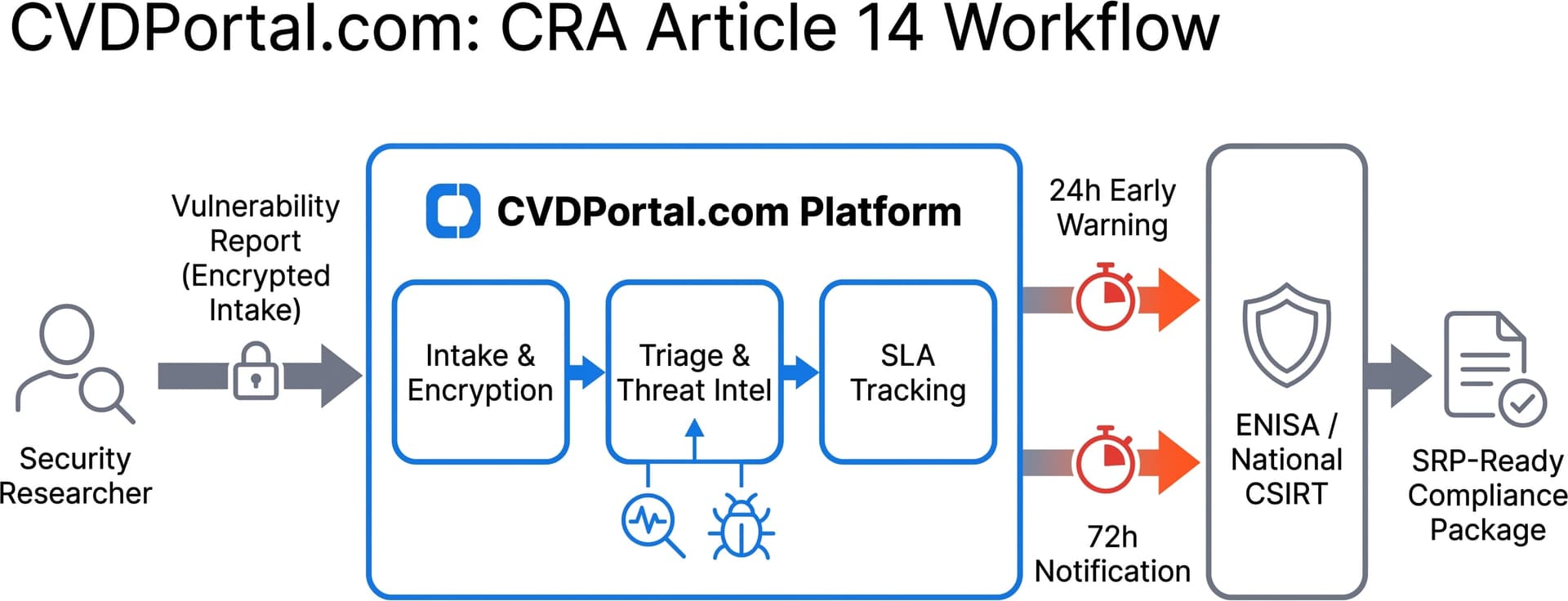
Eight of the ten stages between a vulnerability arriving and an authority notification leaving can be driven by software. Two cannot, and knowing which two is the difference between a working process and an expensive one. This page maps the chain stage by stage with an explicit verdict on each, then shows what we built for the automatable parts.
The short answer
Intake, acknowledgment, enrichment, clock start, deadline tracking, package assembly, advisory generation and the evidence record are all automatable and should be automated, because each of them fails quietly when done by hand under a 24-hour clock. The exploitation judgement is not automatable, because someone has to decide and sign that a vulnerability is being actively exploited. The filing is not automatable either, because the Single Reporting Platform exposes no manufacturer submission API. Nobody has that feature. The duties behind this workflow are set out in the complete EU Cyber Resilience Act guide.
The practical target is therefore not a hands-off pipeline. It is getting the manual step down to a person reviewing an assembled package and pressing submit, with the deadline still hours away rather than minutes.
The chain, stage by stage
From a report arriving to a notification leaving, with an honest verdict on each stage.
| Stage | Verdict | What that means |
|---|---|---|
| Intake | Automatable | A branded HTTPS portal and a monitored address under your own domain, structured submission fields, PGP support, and safe-harbour language. Every report lands in one queue with a timestamp that later becomes evidence. |
| Acknowledgment | Automatable | Automatic receipt to the reporter and a tracked acknowledgment SLA, so the Article 13 single point of contact demonstrably works rather than merely existing. |
| Enrichment | Automatable | CVE and GCVE correlation, EPSS scoring, and known-exploited catalogue matching pulled in automatically against the reported identifier, so the exploitation question arrives at a human with the evidence already attached. |
| The exploitation judgement | Human | Deciding that a vulnerability is actively exploited, or that an incident is severe, is a determination a person makes and signs. Enrichment can present every signal. It cannot make the call, and a tool that claims to is creating liability rather than removing it. |
| Clock start | Automatable | The moment a case is marked exploited, the 24-hour, 72-hour and final-report timers start together and run visibly, with the awareness determination and its timestamp recorded as the anchor for all three. |
| Deadline tracking | Automatable | Hard timers per stage with escalation before each one lapses. The 14-day final-report clock for a vulnerability runs from a fix being available, and the one-month clock for an incident runs from the 72-hour notification, so they are tracked as different clocks rather than one. |
| Triage and remediation | Partly | CVSS scoring, severity workflow, assignment, status transitions and reporter correspondence are all driven by the system. The engineering judgement inside them is not. |
| Package assembly | Automatable | The submission package is built in the shape the Single Reporting Platform asks for at each stage, carrying forward the fields that migrate from mandatory to confirmed, so nothing is retyped between 24 hours and the final report. |
| The filing itself | Human | ENISA exposes no manufacturer submission API for the SRP. A person submits the package and records the reference. Every vendor is in the same position on this, whatever the marketing says. |
| Advisory and evidence | Automatable | A CSAF 2.0 machine-readable advisory on remediation, and a timestamped, exportable record of every intake, acknowledgment, status change and submission for the retention obligation. |
Three claims to check before you buy anything
Each of these is a common vendor position that the Regulation or the platform contradicts.
Nobody can file to the SRP automatically
Article 14(7) routes notifications through the platform established under Article 16, and ENISA does not currently expose a submission API for manufacturers. Automated filing is not a feature any vendor has, because the receiving end does not accept it. Treat a claim of automatic filing as a reason to ask harder questions.
Automation does not lower the reporting threshold
The mandatory trigger is active exploitation, not severity. A critical-scoring vulnerability nobody is using carries no Article 14 duty, and a modest-scoring one being used in real attacks starts the clock immediately. Tooling that reports on CVSS alone will bury your coordinating CSIRT and train your team to ignore the timer.
The clock does not start when the report arrives
It starts on awareness, which Commission guidance C(2026) 5252 defines as reasonable certainty after an immediate initial assessment. That leaves a short documented triage window before the timers run. A system that starts the clock on intake will show you deadlines that are not real.
What we built
CVD Portal runs the automatable eight. A whitelabel disclosure portal on your own subdomain handles intake and acknowledgment, enrichment correlates the report against CVE, GCVE, EPSS and known-exploited data, marking a case exploited starts all three Article 14 timers against a recorded awareness moment, and the submission package is assembled in the platform's own field shape and carried forward between stages.
The property that matters is where those pieces sit. The vulnerability intake that produces the Article 14 trigger and the CRA workspace that classified the product live in the same account, so a report arriving at the weekend starts a clock against a product whose class, support period and Annex I position are already recorded. That is the join most setups are missing, because the disclosure inbox and the compliance spreadsheet were bought separately.
Receiving and tracking reports is free. The Article 14 filing package, CSAF 2.0 advisory export and the compliance workspace sit on the paid tiers. EU data residency by default.
Frequently asked
Can CRA vulnerability reporting be automated?
Is there an API for filing CRA reports to ENISA?
What is CRA incident response automation?
When do you need this in place?
Does this replace a bug bounty platform?
What makes this different from a general GRC tool?
Start the clock on something that can carry it
Set up a branded disclosure portal, connect it to your product records, and have the Article 14 timers ready before 11 September 2026 rather than during the first case that needs them.
Intake and tracking are free. No card required to start.
CVD Portal supports CRA compliance work but does not provide legal advice and does not by itself establish conformity or a presumption of conformity. It is an independent platform, not affiliated with or endorsed by the EU or ENISA.