Accreditation for IEC 62443-4-2 means a national accreditation body has verified a laboratory's competence to test industrial components against international technical security requirements, giving manufacturers independent evidence for their Cyber Resilience Act technical file. That accreditation does not make the laboratory a CRA notified body, and IEC 62443-4-2 does not grant legal presumption of conformity under CRA Article 27.
Key takeaways
- National accreditation bodies under Regulation (EC) No 765/2008, such as ENAC in Spain, DAkkS in Germany, COFRAC in France, RvA in the Netherlands and Accredia in Italy, accredit laboratories under ISO/IEC 17025 to test industrial components against IEC 62443-4-2.
- Under CRA Article 27, IEC 62443-4-2 is a supporting international standard rather than a harmonised standard cited in the Official Journal, so passing IEC 62443-4-2 tests does not confer legal presumption of conformity.
- A CRA notified body must be designated by a Member State notifying authority under Article 35 and listed in NANDO for Regulation (EU) 2024/2847, though national accreditation can support that body's Article 43 competence attestation.
- Industrial manufacturers face full CRA enforcement on 11 December 2027, and early testing against IEC 62443-4-2 closes technical gaps while European harmonised standards under mandate M/606 are finalised.
How do national accreditation, CRA notification and harmonised standards differ?
Accreditation, notification and harmonisation are three separate legal mechanisms in EU product compliance. Mixing them up leads manufacturers to assume an accredited test report completes their conformity assessment when a notified body or additional Annex I evidence is still required.
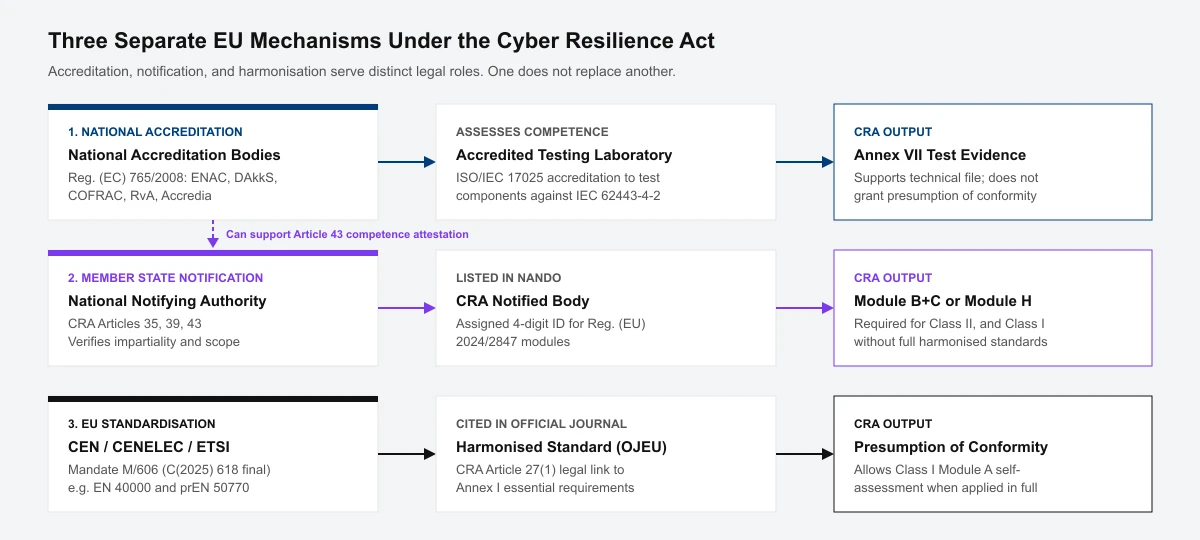
Under Regulation (EC) No 765/2008, each EU Member State appoints one national accreditation body to assess laboratories and certification bodies against international standards such as ISO/IEC 17025. Examples across Europe include ENAC in Spain, DAkkS in Germany, COFRAC in France, RvA in the Netherlands and Accredia in Italy, all operating within the European co-operation for Accreditation (EA) mutual recognition framework.
| Mechanism | Governing basis | What it establishes | Role in CRA conformity assessment |
|---|---|---|---|
| National accreditation for IEC 62443-4-2 | Regulation (EC) No 765/2008 via national bodies (ENAC, DAkkS, COFRAC, RvA, Accredia) | Laboratory competence under ISO/IEC 17025 to test industrial components against IEC 62443-4-2 | Produces independent test evidence for the Annex VII technical file and can support a body's Article 43 competence attestation |
| CRA notified body designation | CRA Articles 35, 39 and 43, listed in NANDO | Authority to perform third-party Module B+C or Module H conformity assessments | Required for Annex III Class II products, and for Class I products when harmonised standards are absent or not fully applied |
| Harmonised standards (e.g. EN 40000 and vertical ENs) | CRA Article 27(1) and mandate M/606, cited in OJEU | Presumption of conformity with the covered Annex I essential requirements | Allows Annex III Class I products to use Module A self-assessment when applied in full |
National accreditation still connects closely to notified body readiness. Under CRA Article 43(4), a Member State notifying authority typically relies on an accreditation certificate from its national accreditation body when notifying a conformity assessment body to NANDO. In Spain, for instance, the draft royal decree implementing the CRA lets the notifying authority rely on ENAC accreditation, as noted in our Spain CRA compliance guide. Even so, manufacturers must verify a body's four-digit number and CRA scope in NANDO before commissioning a formal Module B or Module H assessment.
How does IEC 62443-4-2 map to CRA Annex I requirements?
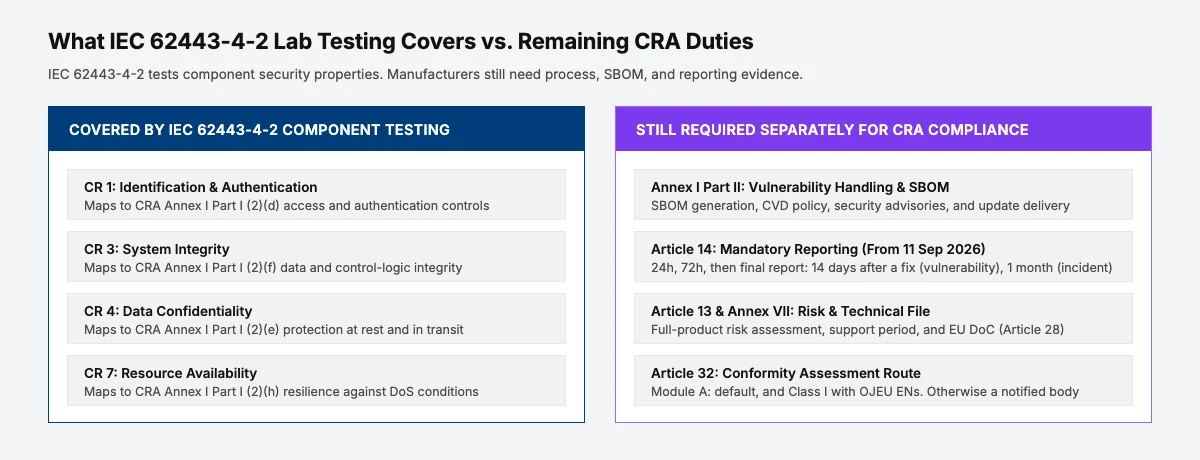
IEC 62443-4-2 defines technical cybersecurity requirements for industrial automation and control system (IACS) components, and its component requirement families align closely with the product security properties in CRA Annex I Part I. Mapping those requirements lets engineering teams reuse accredited lab test results directly inside their CRA risk assessment and technical file.
| IEC 62443-4-2 requirement | Focus area | Closest CRA Annex I reference | Evidence gap that remains |
|---|---|---|---|
| CR 1 (Identification and authentication control) | User and device authentication | Annex I Part I (2)(d) | Default-password removal and product-specific access controls |
| CR 3 (System integrity) | Integrity of data and control logic | Annex I Part I (2)(f) | Secure update integrity and tamper detection outside the component boundary |
| CR 4 (Data confidentiality) | Confidentiality at rest and in transit | Annex I Part I (2)(e) | Cryptographic key management over the full support period |
| CR 7 (Resource availability) | Resilience against denial-of-service conditions | Annex I Part I (2)(h) | Essential-function availability after cyber incidents |
IEC 62443-4-2 focuses on component technical capabilities rather than the manufacturer's post-market processes. Even with a clean IEC 62443-4-2 lab report, a manufacturer must still meet CRA Annex I Part II vulnerability handling duties, maintain a software bill of materials (SBOM), and run Article 14 incident and vulnerability reporting. Our IEC 62443 and ISO 27001 CRA mapping details how both standards align with Annex I and where separate CRA evidence is required.
Why does accredited industrial lab capacity matter before December 2027?
Industrial automation manufacturers face a compressed timeline between standards finalisation and the 11 December 2027 CRA enforcement date. The European Commission issued standardisation request M/606 on 3 February 2025 for 41 CRA standards, including CENELEC's vertical prEN 50770 series aligned with IEC 62443 for operational technology, and none of those vertical standards is cited in the Official Journal yet.
Until harmonised standards are cited in the Official Journal, Annex III Class I industrial products such as network interfaces, routers, switches and network management systems cannot use Module A self-assessment under CRA Article 32. Industrial firewalls and intrusion detection and prevention systems are Annex III Class II products. A Class II product needs a notified body (Module B+C or Module H) whether or not harmonised standards exist.
Wait times at qualified laboratories and notified bodies will tighten as 2027 approaches. Testing industrial components now against IEC 62443-4-2 with a laboratory accredited by a national accreditation body uncovers firmware, authentication and integrity defects early, while building technical evidence that transfers into the Annex VII file.
What should industrial manufacturers do next?
Industrial product teams should treat IEC 62443-4-2 testing as an engineering milestone inside a broader CRA compliance programme rather than a standalone certificate. Take four steps to align lab testing with your 2027 deadline:
- Classify the product under CRA Articles 7 and 8. Determine whether the device is default-class, Annex III Class I, Annex III Class II or Annex IV critical based on its core functionality, because that classification sets whether Module A or a notified body is required.
- Map existing IEC 62443-4-1 and 62443-4-2 evidence to Annex I. Pair component test reports with your STRIDE threat model, secure development lifecycle records, SBOMs and Annex I Part II vulnerability handling procedures.
- Budget for both lab testing and notified body review. Separate the cost and schedule of component security testing from formal Module B+C or Module H assessment, as outlined in our 2027 CRA compliance budgeting guide.
- Verify NANDO status before booking formal conformity assessment. Check the NANDO notified bodies database and follow our notified body selection guide before contracting a third-party CRA assessment.
CVD Portal helps industrial manufacturers and compliance teams compile the Annex VII technical documentation, generate STRIDE threat models mapped to IEC 62443 and Annex I, and manage Article 14 vulnerability reporting so that third-party laboratories and notified bodies receive a complete, structured file.
Primary sources
- Regulation (EU) 2024/2847, the Cyber Resilience Act, CELEX 32024R2847. Articles 7, 8, 14, 27, 32, 35, 39 and 43, Annex I, Annex III, Annex IV and Annex VII.
- Regulation (EC) No 765/2008, setting out the requirements for accreditation and market surveillance relating to the marketing of products, CELEX 32008R0765.
- Commission CRA Standardisation Request M/606, Implementing Decision C(2025) 618 final of 3 February 2025.
- NANDO Notified Bodies Database, European Commission Single Market Compliance Space.
Frequently asked questions
Does accreditation for IEC 62443-4-2 make a laboratory a CRA notified body?
No. Accreditation by a national accreditation body under Regulation (EC) No 765/2008 attests technical competence to test against a standard, whereas CRA notified body status requires Member State designation under Article 35 and listing in the European Commission NANDO database under Regulation (EU) 2024/2847.
Does an IEC 62443-4-2 test report give presumption of conformity with the CRA?
No. Under CRA Article 27, only harmonised standards cited in the Official Journal of the European Union, common specifications, or qualifying European cybersecurity certification schemes grant presumption of conformity. IEC 62443-4-2 provides supporting technical evidence for Annex I.
Which national accreditation bodies accredit laboratories for IEC 62443-4-2 in the EU?
Each EU Member State designates a single national accreditation body under Regulation (EC) No 765/2008, such as ENAC in Spain, DAkkS in Germany, COFRAC in France, RvA in the Netherlands and Accredia in Italy. Those bodies assess laboratories against ISO/IEC 17025 for specific test scopes including IEC 62443-4-2.