Coordinated Vulnerability Disclosure
Coordinated vulnerability disclosure (CVD) is how the security industry agrees to handle newly discovered flaws: researcher reports privately, vendor fixes, public learns once a remediation is available. This page covers what it is, why it exists, and the seven steps to operate one for an EU manufacturer under the Cyber Resilience Act.
The three disclosure models
Full disclosure. The researcher publishes findings immediately, without coordinating with the vendor. Maximises public information, maximises exposure window before a patch exists.
Non-disclosure. The vulnerability is kept secret, often for offensive use. Common in nation-state and grey-market contexts. Externally indistinguishable from a vendor that has no security culture.
Coordinated disclosure. The default professional norm. The researcher reports privately to the vendor, an agreed timeline is set, the remediation ships, and the advisory publishes alongside or shortly after. ISO/IEC 29147 codifies the practice.
Seven steps to operate a CVD process
The minimum operational set for an EU manufacturer under Article 13 of the Cyber Resilience Act, with Article 14 reporting at the end where applicable.
- 1
Publish a CVD policy
A short public document that describes scope, authorised testing methods, the reporting channel, your acknowledgment timeline, your remediation target, and a safe-harbor statement. Reference ISO/IEC 29147 for the framing. Under CRA Article 13(8) this is a regulatory obligation for EU manufacturers of products with digital elements.
- 2
Set up a single point of contact
A monitored intake channel under your brand. A whitelabel email and a structured submission form on a hosted policy page are the minimum. Add the reporting address to your security.txt file at /.well-known/security.txt, which is the machine-readable half of the same contact.
- 3
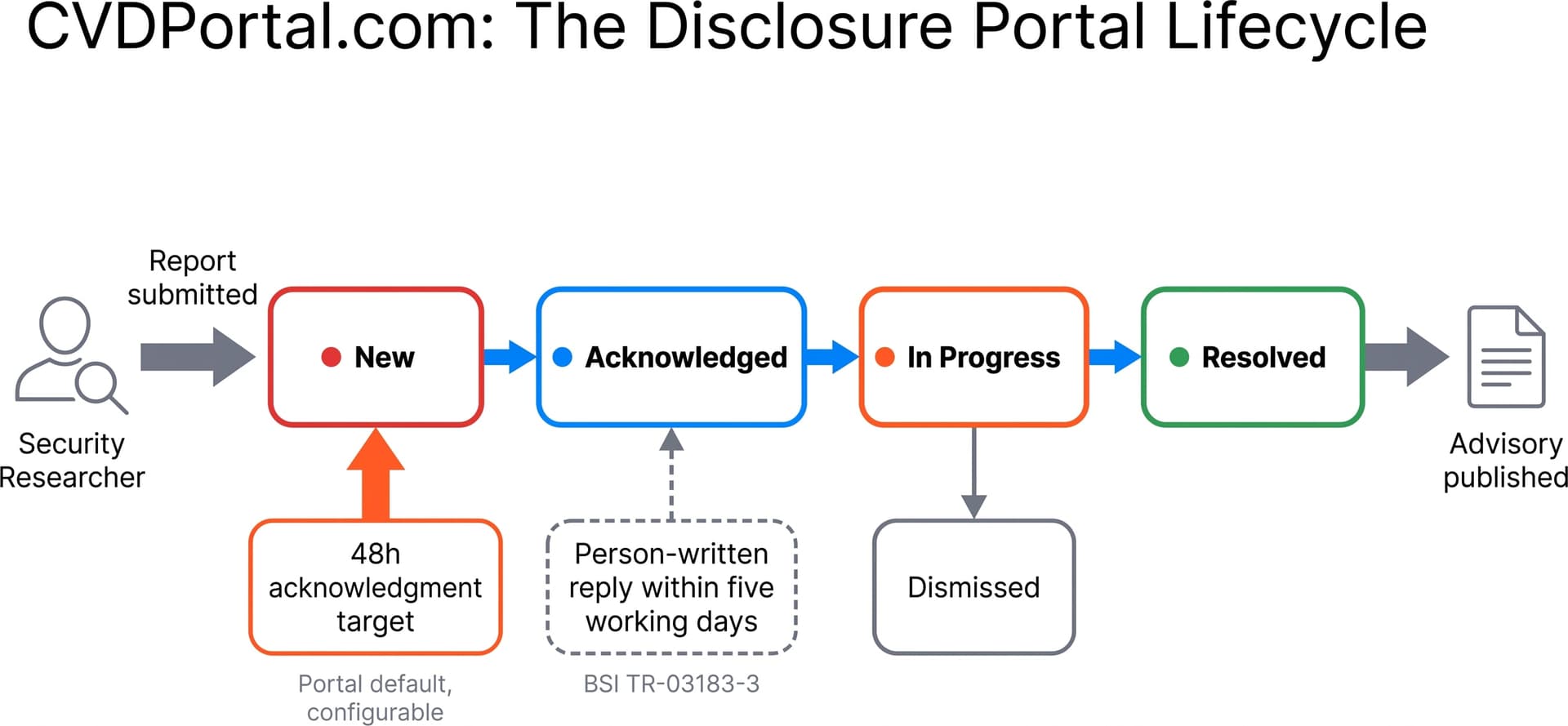
Acknowledge within 48 hours
48 hours is the CVD Portal default, not a statutory deadline. BSI TR-03183-3 requires a simple response written by a person, never an automated reply, within five working days. Auto-acknowledge on receipt if you like, then assign a triage owner the same day and follow up in person.
- 4
Triage and assess severity
Confirm the vulnerability, determine severity (CVSS 3.1 or 4.0), check for duplicates, and decide on a remediation target date. Communicate the timeline to the reporter.
- 5
Coordinate disclosure
Agree an embargo date with the reporter. The default norm is publication around the remediation release. Active exploitation may justify earlier disclosure; pending CSIRT coordination may justify later. Document the rationale either way.
- 6
Publish an advisory
Issue a security advisory describing the vulnerability, affected versions, and mitigation. CSAF 2.0 is the machine-readable industry standard. Credit the reporter unless they request anonymity.
- 7
Report to regulators where required
Under CRA Article 14, actively exploited vulnerabilities and significant incidents trigger a 24h early warning to ENISA and the relevant national CSIRT, followed by a 72h detailed report and a final report. Track these deadlines explicitly.
Frequently asked
What is coordinated vulnerability disclosure?
What is the difference between CVD and a VDP?
Is CVD mandatory under the EU CRA?
How long does the coordinated disclosure period last?
What if the researcher does not agree to coordination?
What is a CSAF advisory?
Official guidance and further reading
Authoritative CVD resources from national cyber security agencies and the incident response community.
- Establishing a Coordinated Vulnerability Disclosure Program to Work With Security Researchers
Joint guide from CISA, NSA, JPCERT/CC, NCSC-NL, and NCSC-UK (July 2026). Covers policy design, safe harbor, security.txt, CVE assignment, CSAF publication, and researcher recognition. Explicitly notes that the EU CRA requires suppliers to maintain a vulnerability disclosure policy.
- The NCSC Vulnerability Disclosure Toolkit
The UK National Cyber Security Centre's practical toolkit for setting up a disclosure process. Communication, policy, and security.txt in a compact package.
- FIRST Vulnerability Coordination SIG
The Forum of Incident Response and Security Teams' guidelines and practices for multi-party vulnerability coordination and disclosure, for cases involving several vendors or coordinators.
- CERT Guide to Coordinated Vulnerability Disclosure
Carnegie Mellon CERT/CC's comprehensive reference on CVD roles, phases, and edge cases, including public awareness and silent-fix pitfalls.
Stand up a CVD process in under an hour
CVD Portal handles all seven steps: published policy, whitelabel intake, acknowledgment SLA, triage, coordinated timeline, CSAF advisory, and Article 14 reporting cascade.