What is a vulnerability disclosure platform under the Cyber Resilience Act?
A vulnerability disclosure platform is the channel where security researchers report product flaws. Under the Cyber Resilience Act, manufacturers use one to meet the Annex I Part II duties to enforce a CVD policy and publish a reporting address.
Why VDPs exist
Security researchers find vulnerabilities. Without a clear, published channel, those findings either get published unilaterally (full disclosure), sold on grey markets, or sit on a researcher's laptop indefinitely. A VDP makes coordinated disclosure the path of least resistance. It is the difference between learning about a flaw from a researcher email and learning about it from a journalist asking for comment.
ISO/IEC 29147 is the international standard for vulnerability disclosure processes. ISO/IEC 30111 covers internal handling. Together they describe what a competent VDP looks like. The CRA now turns parts of this into a binding obligation for EU manufacturers.
Six components of a real VDP
Anything calling itself a vulnerability disclosure platform should cover all six. If something is missing, you will pay for it in coordination overhead later.
Published policy with safe-harbor language
Researchers will not report into a black box. The policy should describe scope, authorised testing methods, response timelines, and a clear safe-harbor statement that protects good-faith research.
Structured intake under your brand
A whitelabel form and email address (security@yourcompany.cvdportal.com or your own domain) collect reports in a consistent shape. PGP support matters for sensitive submissions.
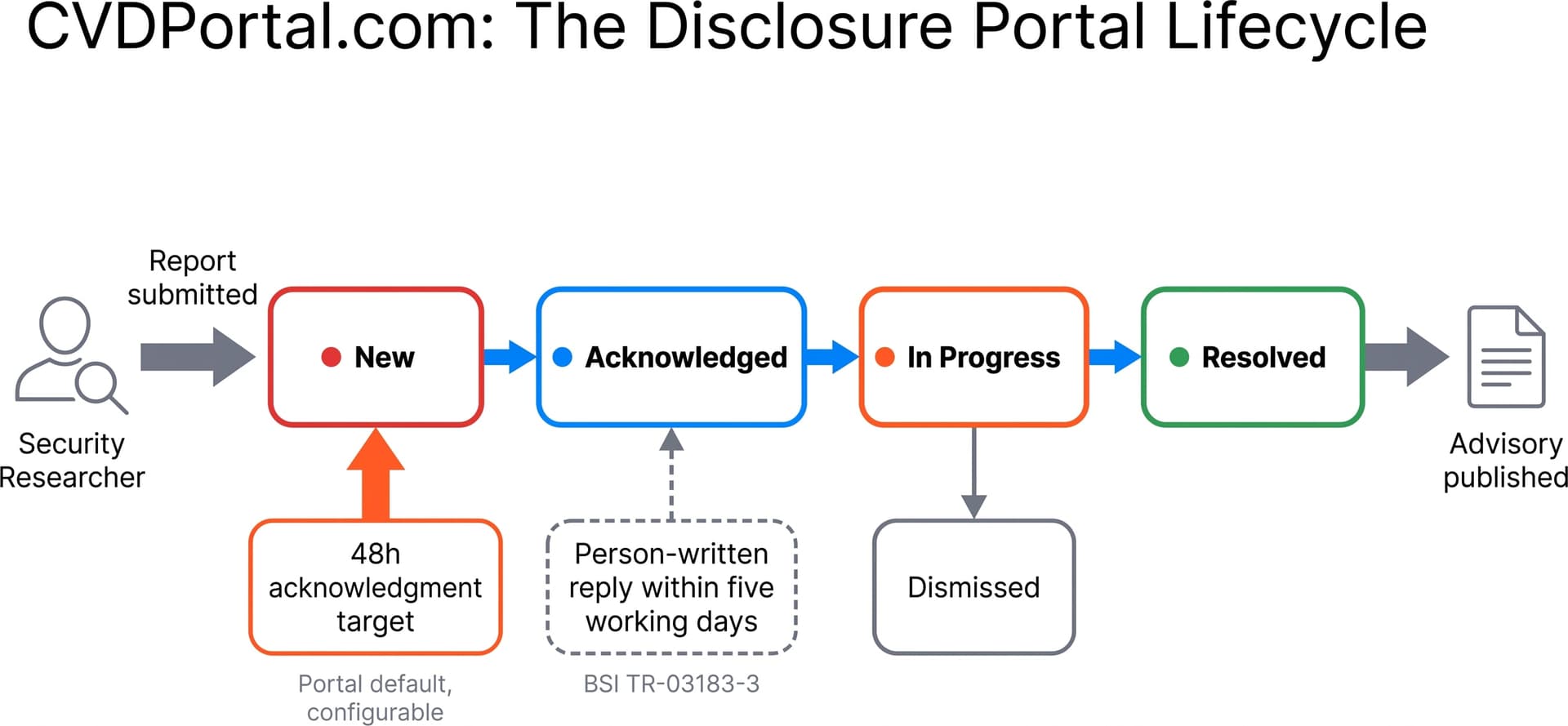
Acknowledgment SLA
48 hours is the CVD Portal default, not a statutory deadline. BSI TR-03183-3 requires a simple response written by a person, never an automated reply, within five working days. The platform should track both clocks and the responder follow-up.
Triage workflow
Severity assessment, duplicate detection, status tracking, and internal handoff to engineering. Without this the inbox becomes the bottleneck.
Coordinated disclosure timeline
Agreed-upon disclosure date, embargo handling, and a clean publication of the resulting advisory. CSAF 2.0 is the machine-readable format expected by the security industry.
Audit trail
Timestamps on every event. Required for regulator-facing posture under the CRA and useful for internal post-mortems.
Frequently asked
What is a vulnerability disclosure platform?
Is a VDP the same as a bug bounty platform?
Does the EU CRA require a VDP?
What is the difference between a VDP and a CVD portal?
How long does it take to stand up a VDP?
How does CVD Portal differ from generic VDPs?
Run your VDP on a CRA-native platform
Whitelabel intake. 48h acknowledgment tracking. Article 14 reporting workflow. EU data residency by default.